A storage container on your own land: what to plan for
Buying or renting, delivery, ground preparation, insurance and notifying the town hall: what a storage container on your own land involves, and when a container at a storage facility is enough.
Contents
Storing in a container at home: the short version
Putting a storage container on your land requires four things. You need a container, bought or rented, a way to deliver it to the chosen spot, ground that can support it, and often paperwork to complete at the town hall. As a general rule, a 20-foot container covers more than 5 m² of ground, the threshold below which a garden shed requires no paperwork.
The plan works if you have the space and want your belongings close at hand. It does take more organisation than it seems, from placing the order to getting the container taken back.
Buying or renting the container
If you buy, the container is yours. You keep it as long as you like, then you sell it or have it removed, which means another lorry visit.
If you rent, a supplier delivers it, then collects it at the end of the contract. Read the offer right to the end. The monthly rent is sometimes shown excluding VAT, and in the offers we looked at on 14 November 2026, it excludes the round-trip transport and the deposit. Those are two lines to add before you compare.
Either way, the container arrives empty. Loading it, organising your belongings and providing lighting are your responsibility.
Getting the container to its spot
A 20-foot container is roughly 6 m long on the outside. It arrives by lorry, and is usually set down with lifting equipment or from a flatbed. You therefore need access wide enough for the lorry, with no cable, branch or narrow gate in the way.
Ask the supplier what access its lorry needs, then check your land against those requirements. A sloping street, a tight bend or access shared with neighbours can often mean changing your plans.
The ground matters as much as the access. A full container is heavy, and it has to sit flat on a stable surface. On a lawn or on soil that becomes waterlogged in winter, it may sink or tilt.
Planning formalities
The French planning code (code de l'urbanisme) does not specifically mention containers. Its rules are based on area and duration, as outlined on the Service-Public page on garden sheds, last checked on 21 March 2025.
So it is your town hall that tells you whether your container counts as a building under its local urban plan (PLU), and which procedure applies.
For a freestanding garden shed, Service-Public sets out the general framework. Up to 5 m², there are no formalities. From 5 to 20 m², you need a prior declaration (déclaration préalable), and above 20 m², a building permit (permis de construire).
The code sets the same threshold for new buildings. Under its article R421-9, a footprint of more than 5 m² and no more than 20 m² falls under the prior declaration, for a height of no more than 12 m.
With nearly 14 m² inside, a 20-foot container falls within the size range requiring a prior declaration if it is treated as a building. The PLU can add its own rules, on siting or appearance for example. And if the PLU sets no distance, Service-Public states that a garden shed goes on the property boundary or at least 3 m from it.
Some areas call for more caution: the surroundings of a listed historic monument, a protected site, a remarkable heritage area (site patrimonial remarquable). Service-Public places them among protected areas, where the thresholds change, and also refers to the development tax.
Before ordering, take the container's outside dimensions to your town hall's planning department. It receives the application and knows the PLU.
Security and insurance at home
At home, security is up to you. A container visible from the street catches the eye, and its door is only as good as the padlock you fit. Lighting, a door facing the house or a spot out of sight help to protect it.
For insurance, ask your home insurer before filling the container. Ask whether its contents are covered, in which cases and up to what value, since it is not a room of the house.
Storage at a facility: the other option
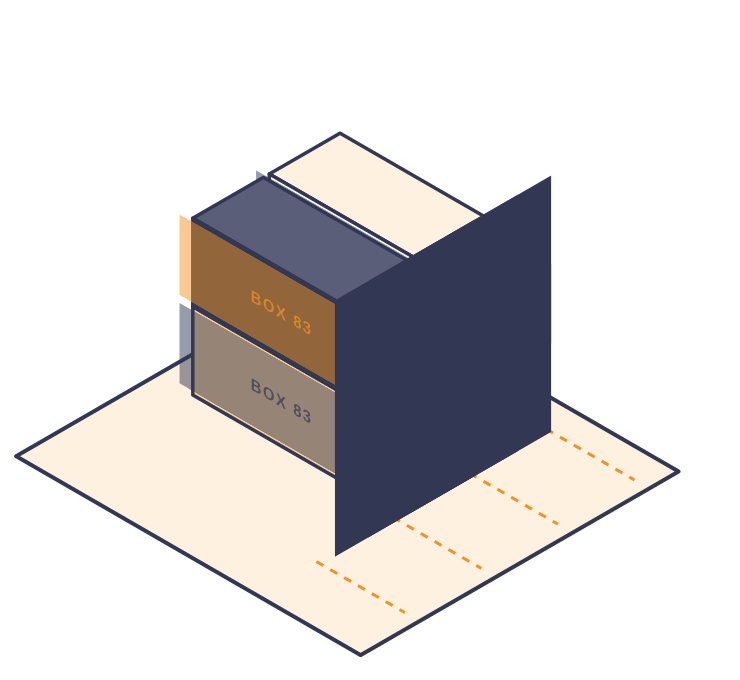
If you do not have the space or access for a delivery lorry, or do not want to prepare an application, you can use a container elsewhere. That is how BOX 83 works. Its watertight 20-foot shipping containers, each offering 33 m³ of storage space, are located on a site in the ZAC du Capitou in Fréjus, at A8 motorway exit 38.
The site is fenced and lit. The gate opens with your code, cameras watch over the site and an alarm takes over at night. Your belongings are insured up to €3,000, and you drive or take a van right up to the door, every day from 6am to 9pm.
There is a trade-off, and it is better to say so plainly. Your belongings are no longer at the bottom of the garden, and every visit means a trip. If you come for something every day, a container at home keeps an advantage.
Otherwise, the price depends only on your dates: a net price of €250 for a full month, with the rules set out on the prices page. The storage container rental in Fréjus page presents the site, and the article how much does a storage unit cost helps you compare with a unit.